
Japanese seeds, Indian fields: how ICHIGO works
If you’ve eaten a strawberry in Tokyo, you remember the smell first. A box of Japanese strawberries opened in a department-store basement perfumes the air ten metres away. That perfume isn’t an exotic cultivar trick. It’s a chain of small choices — what cultivar you sow, where you sow it, when you pick, how you pack — that the Indian strawberry market has rarely been asked to make. ICHIGO is what happens when somebody asks.
What’s actually in the box
ICHIGO is Japanese strawberry seeds, planted in Indian fields, under Japanese agricultural supervision.


The cultivars are SAKURA and HARUHI, both F1 hybrids from the Berry Pop series bred by Miyoshi & Co., Ltd. in Tokyo. Miyoshi has been breeding ornamental and edible plants for over a century, and the Berry Pop strawberry series was selected specifically for the traits Japanese pastry chefs reward: even ripening, firm flesh that holds a knife cut, a Brix–acid balance that makes the berry interesting on its own (not just sweet), and a perfume that arrives at room temperature.
The cultivation happens in Maharashtra, in plots run by M2labo Bharat — the Indian operating partner — under the technical supervision of a Japanese PhD in agricultural science. Each season’s seed is imported under a royalty agreement with Miyoshi (it’s why the ICHIGO logo says “Produced by M2labo Bharat” on the box).
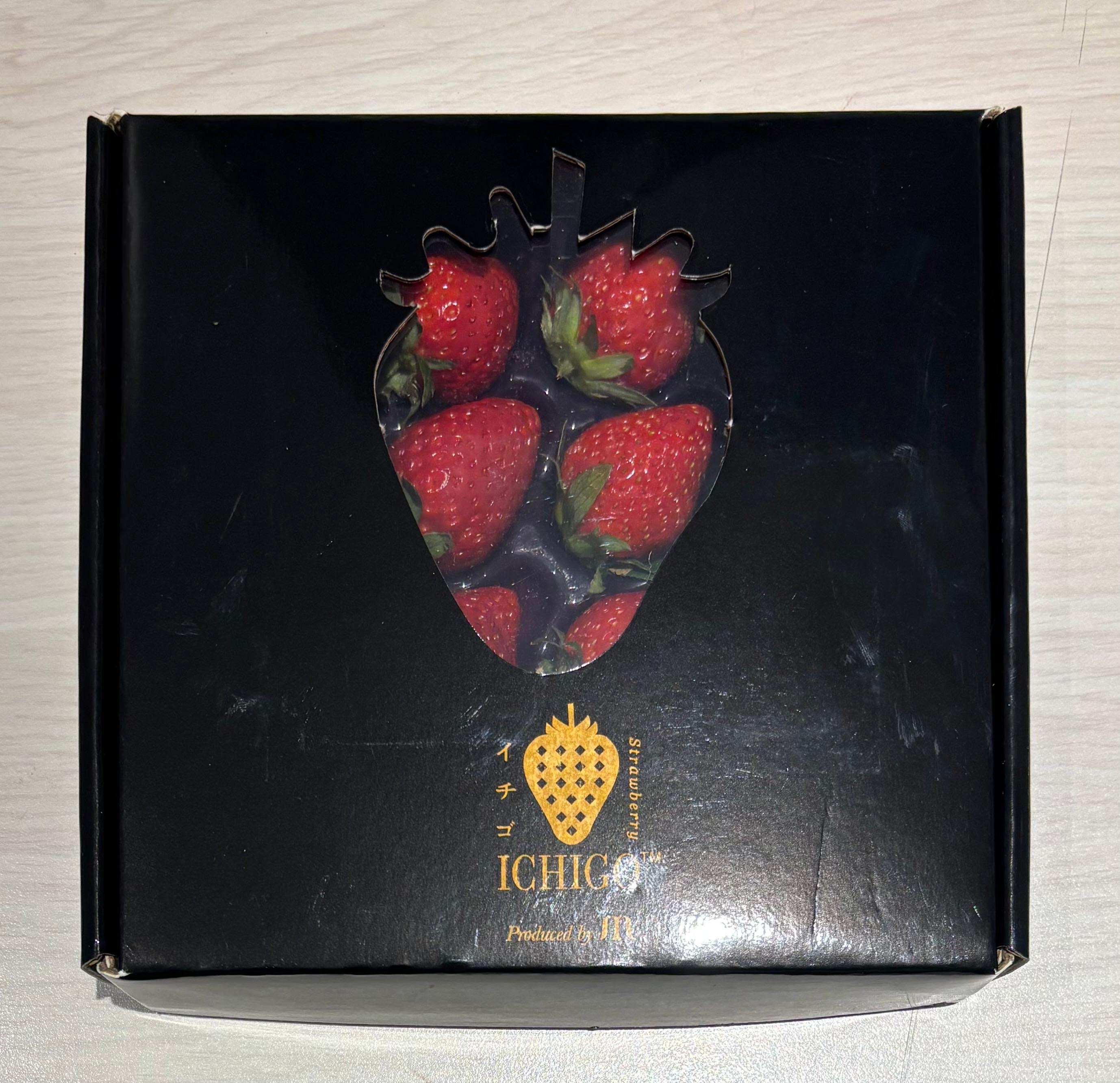
The boxes themselves you’ll start to recognise: matte black cardboard, a single strawberry-shaped die-cut window, gold “ICHIGO” and katakana “イチゴ” on the front. Inside, a single layer of berries, calyx-up, padded.
Why bring Japanese cultivars at all?
The Indian strawberry market is dominated by three cultivars: Sweet Charlie, Winter Dawn and Camarosa — all bred for the American eastern seaboard, all adopted in India after 2000 because they tolerate the climate and yield well. They are workhorses.
What they were not bred for is the dessert-counter shelf life or the calyx integrity or the perfume that Japanese pastry programs depend on. A Sweet Charlie at peak ripeness in a Pune field tastes fine. A Sweet Charlie that survived a 14-hour road journey to a Mumbai patisserie has lost its calyx, its firmness and its scent.
SAKURA and HARUHI were bred against a different brief — and ICHIGO is the experiment of bringing that breeding work into an Indian production system, instead of importing the finished berry from Japan (which would be expensive, slow, and pointless given India’s growing windows).
Three operational disciplines on top of the cultivar
Cultivar choice is necessary but not sufficient. Three field practices that go with the seed:
1. The pick window
The single largest determinant of a strawberry’s flavour at the customer is what colour it was when it left the plant. The Indian convention is later harvest — fully red, slightly soft — to maximise weight. The ICHIGO standard is one to two days earlier, on a deeper red but still firm berry. That single change moves Brix up by roughly 1.5 points, because the berry hasn’t started spending its own sugars on respiration.
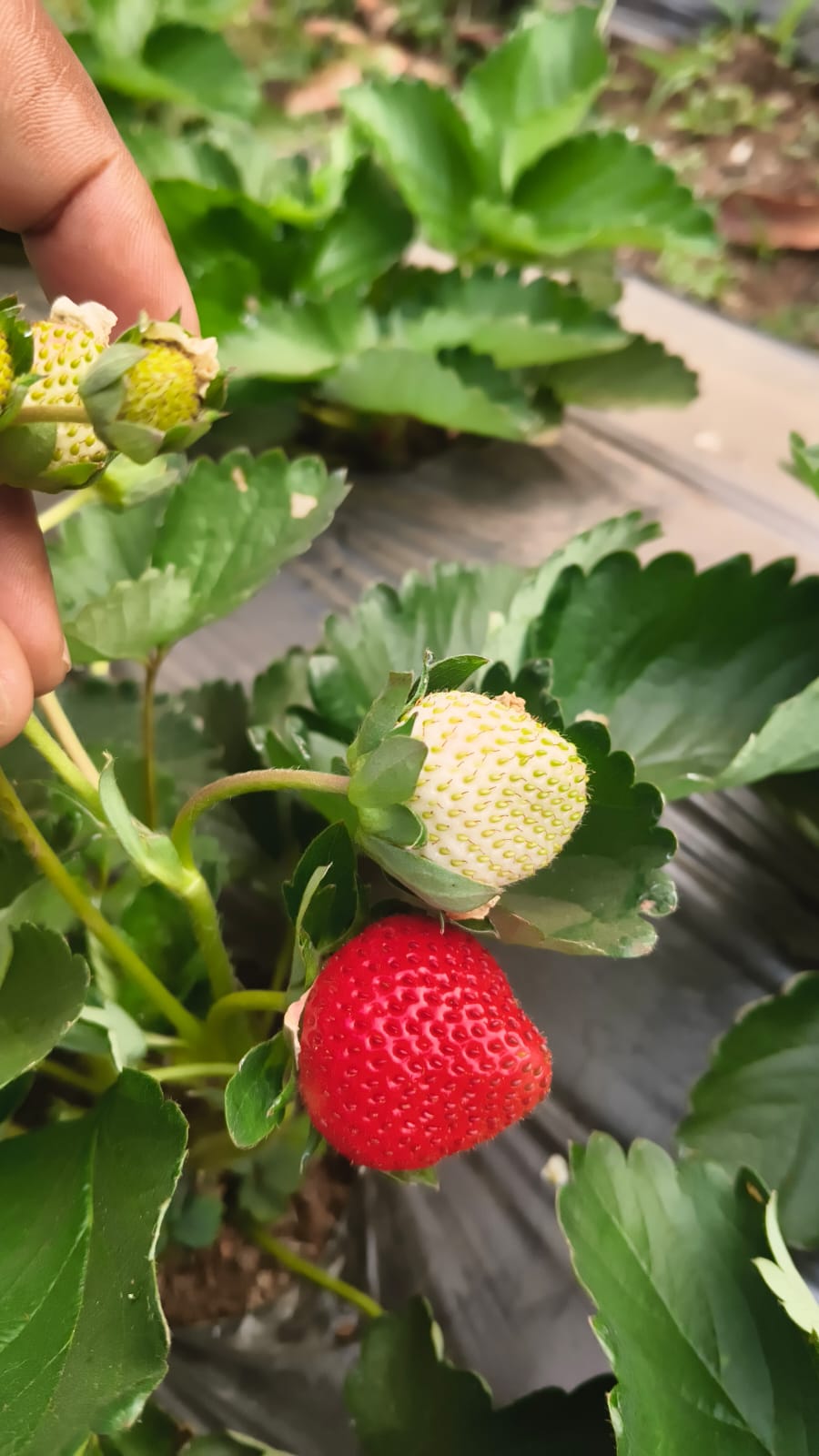
The reason you train pickers on the plant, not the harvested crate, is that once a berry is picked the colour information becomes ambiguous. The pickers learn that the white-shouldered one in the picture above is one day too early; the deep-red-with-firm-shoulders sister beside it is the ICHIGO target.
2. Pre-cool within two hours
A strawberry at 22 °C respires fast enough to lose noticeable sugar in four hours. The standard Indian field practice is to truck warm berries to a market shed and let the night handle cooling. The ICHIGO discipline is that every picked punnet reaches a 2–4 °C pre-cool dock within two hours of leaving the plant, and the pre-cool dock is at the farm cluster — not at a distant warehouse.
3. Single-layer packing in a window box
Stacking berries two deep looks fine on the day. By the time the punnet reaches a chef in Mumbai, the bottom layer is bruised. ICHIGO packs single-layer, calyx-up, in the branded black window box. The window isn’t decorative — it lets the buyer inspect the goods before opening, which is the difference between a B2B chef saying “looks good, take it inside” and an inspection-on-receipt return.
A test you can do on receipt
You don’t need a refractometer to tell an ICHIGO box from a generic one. On receipt:
- Smell the box before you open it. ICHIGO boxes carry the perfume at room temperature within ten seconds of breaking the seal. Generic Indian premium boxes rarely do.
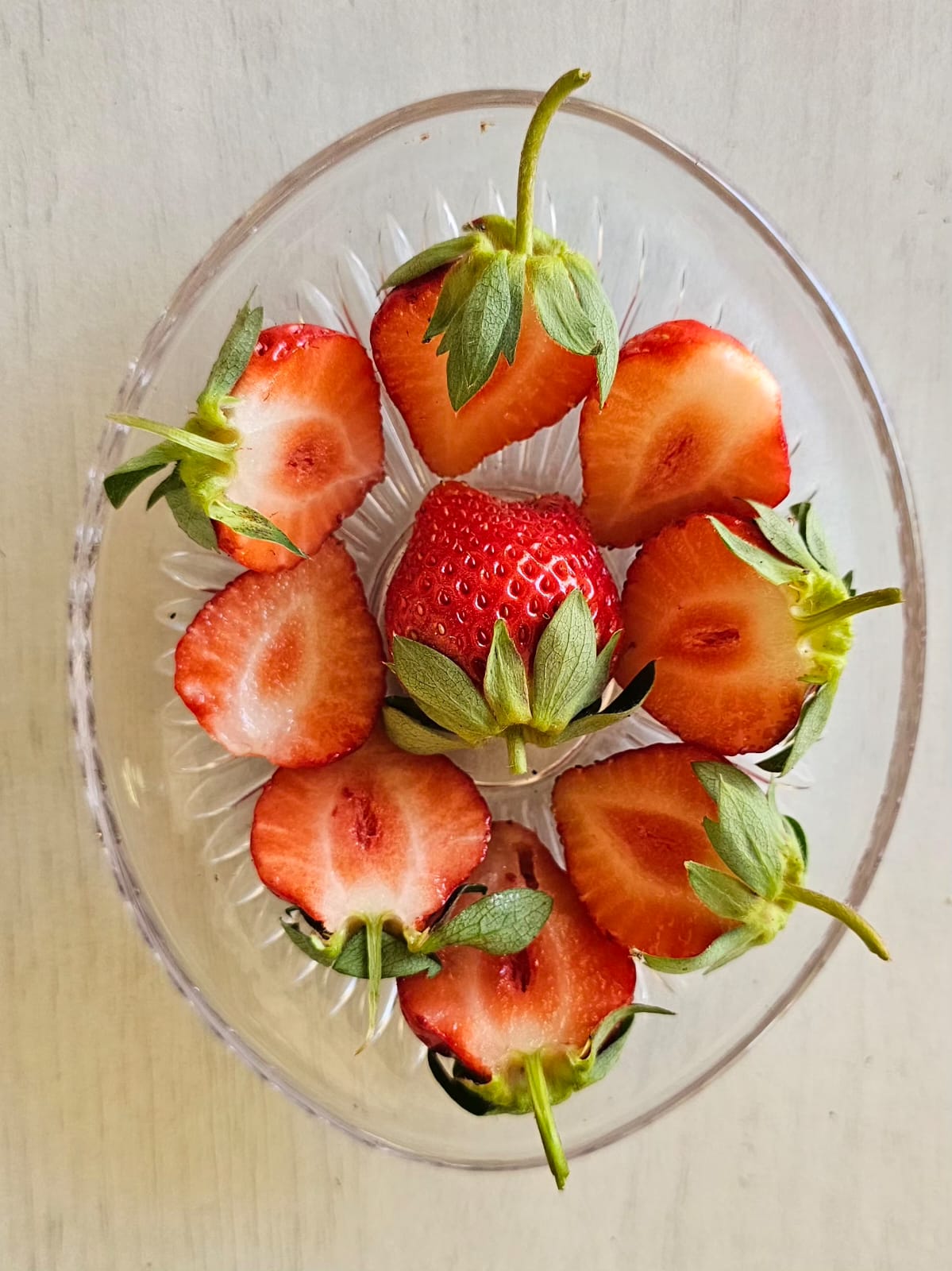
- Slice one berry vertically. A flat-bred Indian cultivar usually shows a pale, hollow centre — visible in the cross-section above as the lighter inner region. SAKURA and HARUHI fill the centre with deep, uniform red. That uniformity is what lets a pastry chef cut a clean slice for plating.
- Eat the worst-looking berry, not the best. If the worst one tastes good, the box was handled correctly. If the worst one tastes flat, the box was kept warm somewhere along the way. This is the only test most chefs don’t do, and it’s the one that separates a careful supplier from a marketing claim.
What ICHIGO is not
ICHIGO is not airfreighted from Japan. Doing so would be wasteful, expensive, and unnecessary — Indian growers in the right altitude bands can produce excellent fruit with the right seed and the right handling. ICHIGO is the experiment of pairing Japanese cultivars and Japanese discipline with Indian cultivation.
It is also not a single-cultivar gift-counter luxury. SAKURA and HARUHI are positioned for the kitchen — pastry chefs, hotel F&B, dessert-first restaurants — at a price that makes weekly reorders economically sensible. The ₹800-for-six-berries Tokyo model is a different market and is not what this is.
What’s next
We’re a few seasons into this work. The two cultivars are settling into specific Maharashtra plots, the supervisory data is feeding back into next-season seed orders, and the buyer side is starting to expand from Mumbai and Pune outward. The next pieces in this Journal will walk through the cold-chain (article 2), the farm-side stories (article 3), and the chef-side reception (articles 4 and 7).
In the meantime, order a box. Smell it before you open it. Eat the worst-looking berry. Tell us what you find.
ICHIGO is a registered Indian trademark of M2labo Pvt. Ltd. Strawberries are grown in India by M2labo Bharat under licence from Miyoshi & Co., Ltd. for the SAKURA and HARUHI Berry Pop F1 cultivars. India business contacts: Ishita Shroff — +91 98314 79900, Mitesh Furia — +91 98207 73767.
Japanese strawberry quality, grown in India's hills.
Home delivery and business quantities, cold-chain across Mumbai, Pune, Bengaluru, Chennai and Hyderabad.