
It starts with a seed: raising Japanese strawberries from seed in India
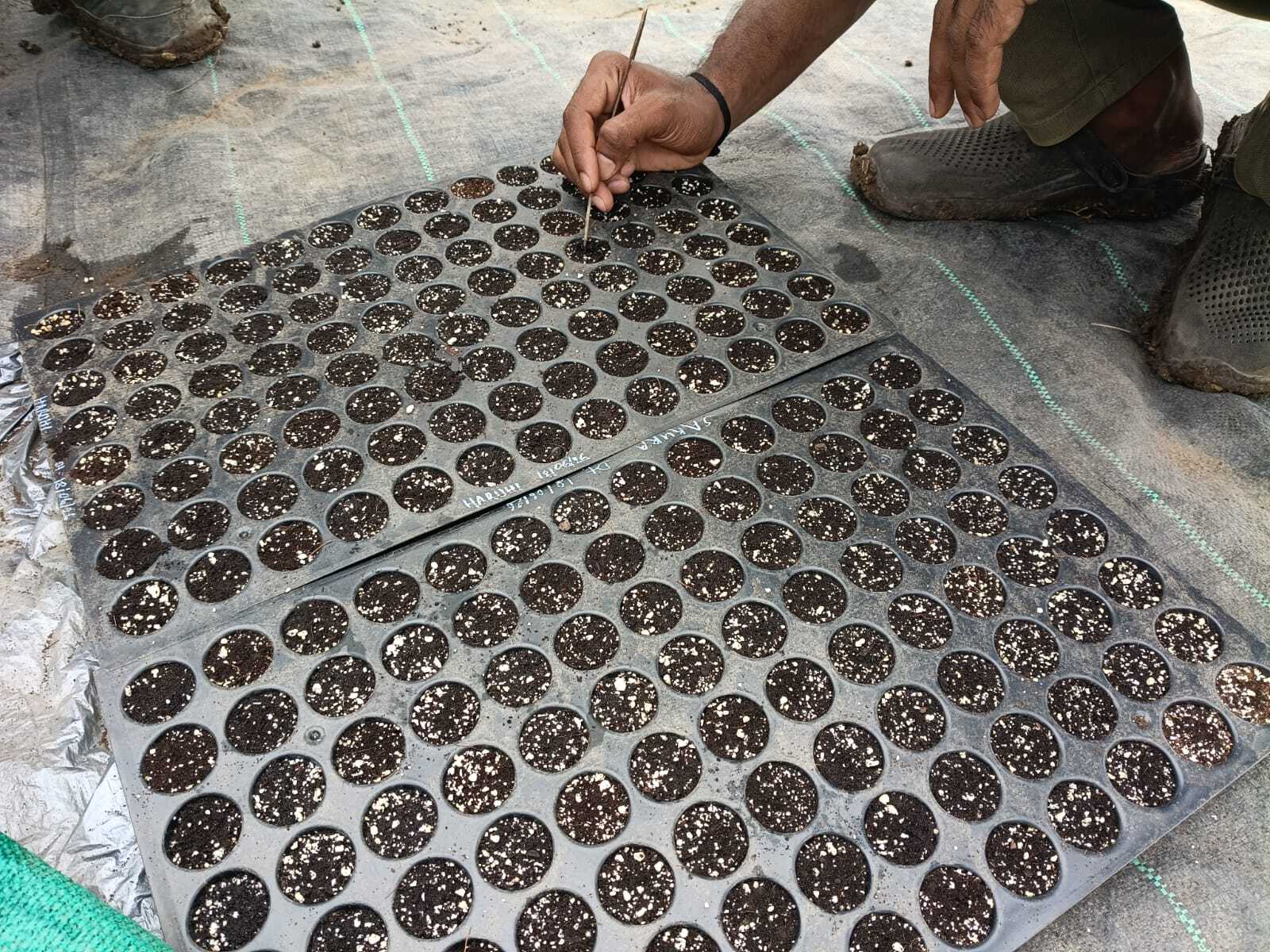
Ask where a strawberry comes from and most people picture a field. But a field is the middle of the story. The beginning is much quieter, and it happened this week: the first seeds of the coming season going into the ground — or rather, into trays — at our grower partner’s polyhouse in India.
On 23 June, the team began sowing. Over the next week or so they’ll work cell by cell through tray after tray, and everything that becomes an ICHIGO berry months from now is being decided right here, before there’s a single leaf to show for it.
It starts as a seed, not a clone
This is the part that makes our nursery different from most strawberry cultivation you’ll see in India.
The standard way to start strawberries here is from runners — the little daughter plants a mother plant throws out on a stem. You cut them, root them, and plant them out. It’s cheap and it’s fast, but it’s also cloning: every runner inherits whatever the mother was carrying, including viruses and disease that quietly build up season after season. That’s a big part of why field strawberries get less reliable over time.
We start from seed. Our cultivars are Miyoshi & Co’s Berry Pop F1 series — SAKURA, bred for sweetness and aroma, and HARUHI, bred for a stable sugar–acid balance and year-round consistency — and they are seed-propagated F1 hybrids, which is still rare for strawberries anywhere in the world.
Starting from seed buys three things a runner can’t:
- A clean start. Seed doesn’t carry the mother plant’s virus load. Each season begins genuinely fresh, not one generation further down a slow decline.
- Uniformity. F1 seed produces an even, predictable crop — plants that flower together, ripen together, and grade together. That’s what lets a kitchen plan around us.
- The real variety, raised here. These aren’t berries flown in from Japan. They’re Japanese cultivars grown in India, from seed, under Japanese agricultural supervision — the genetics of a premium plate, on Indian soil-free beds.
The medium is built, not dug
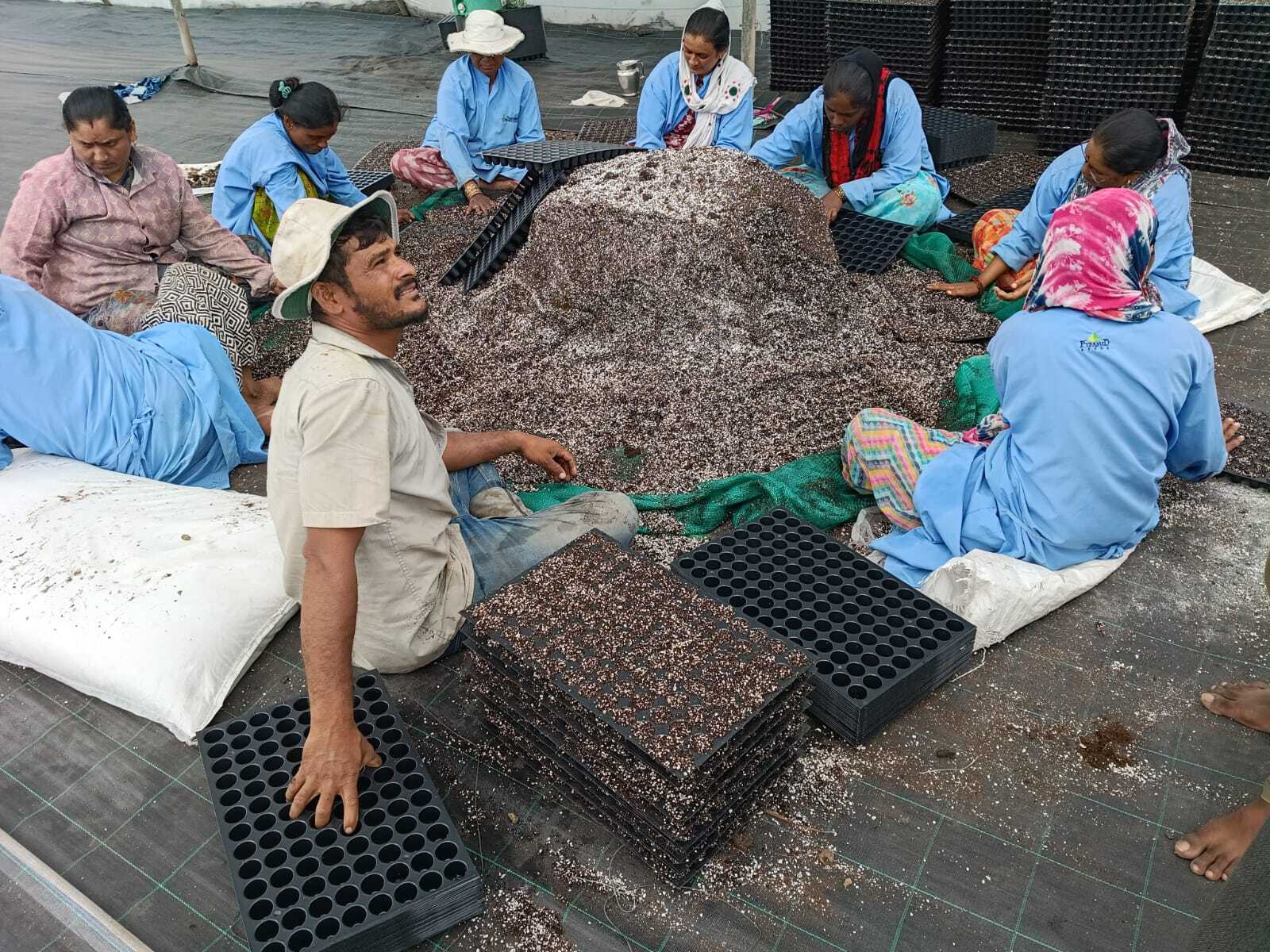
Notice what the seed is going into. Not soil — a prepared, soil-free growing medium, mixed and then hand-packed into plug trays, one even cell at a time.
That choice is deliberate and it starts on day one. Soil carries disease, pests and inconsistency; a clean medium gives every single seedling the identical root environment, so a tray from one end of the bench behaves exactly like a tray from the other. It also means the plant is soil-free from its very first root — the same principle that carries all the way through to the vertical, soil-free towers it will eventually grow in. Consistency isn’t something we add later. It’s built into the first handful of medium.
It’s careful, manual work. Filling trays, levelling them, and placing seed by hand is slow — but it’s the cheapest insurance you can buy for a season, because a weak or uneven start can’t be corrected downstream. You either raise an even nursery or you spend the whole season fighting the gaps.
A clean house, ready and waiting
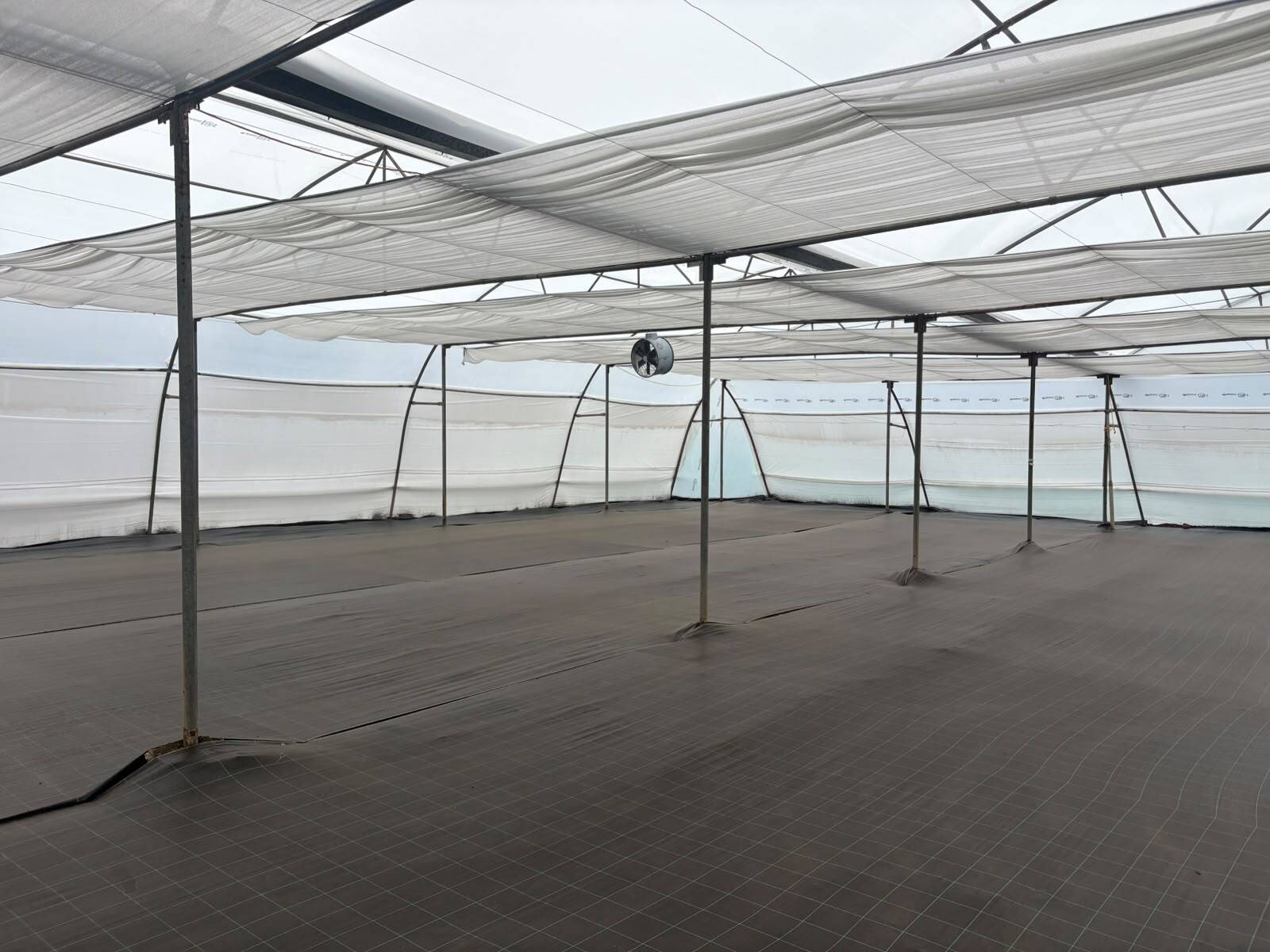
This is where those trays are headed — a polyhouse, swept, screened and laid out, waiting for the seedlings.
The empty house isn’t idle; it’s prepared. The structure and shade screens hold temperature and humidity steady and keep monsoon rain off young plants, and the ground cover keeps the growing area clean. By the time the seedlings are strong enough to move, the environment they move into is already controlled — not an open field at the mercy of the weather, but a climate we set on purpose. A protected, managed house is what makes a long, steady season possible instead of a single hopeful harvest.
From this seed to your kitchen
So here’s the timeline you’re looking at. Sowing runs through this week. Then several weeks of nursery-raising while the seedlings find their feet. Then they’re transplanted into our vertical, soil-free grow-towers under the polyhouse, where the method we’ve written about before takes over — lean feeding through growth, lifting as the fruit colours, a pick window measured in hours, and a single calyx-up layer into the box.
It’s a long way from a tray of seed to a box on a restaurant’s dock. But every good thing about the berry at the end — the perfume, the even ripening, the reliability week after week — is being set right now, by hand, before the first leaf is even open.
Behind the operation is M2labo Bharat Pvt. Ltd., the India arm of Japan’s M2Labo, backed by Suzuki — which is the boring but important part: a nursery that will be sown again next season, and the one after that.
Taste it from the source
Tell us your city, the dishes you’re building, and a rough weekly volume, and we’ll come back with grades, pack sizes, crate prices and the nearest delivery schedule — and, when this season’s fruit is ready, a sample box straight from the field these seedlings are headed to.
→ Request a sample box and current crate prices on our contact page.
- 📞 Ishita Shroff — +91 98314 79900
- 📞 Mitesh Furia — +91 98207 73767
- ✉️ contact-bharat@m2-labo.jp
ICHIGO™ — Japanese strawberry cultivars, grown in India from seed. Produced by M2Labo (M2labo Bharat Pvt. Ltd.).
Japanese strawberry quality, grown in India's hills.
Notes from the farm, the cold chain and the chefs putting Indian strawberries on the world's tables.